AI Voice Agents
How to build AI voice agents. Full-stack tutorials using ElevenLabs, Deepgram, Twilio, and Whisper for real-time AI phone agents.
Eight Labs
AI Builder Education · TheAIHow · Updated April 2026
What is AI Voice Agents?
An AI voice agent is a software system that combines speech-to-text transcription, large language model reasoning, and text-to-speech synthesis to enable real-time, conversational AI through voice — over the phone, through a browser interface, or via smart speaker. Unlike chatbots that process typed text, voice agents operate under a strict latency budget: they must transcribe spoken audio in real time, reason about the appropriate response, generate natural-sounding speech, and deliver it back to the user — all within under one second to maintain conversational flow. Voice agents are increasingly deployed for customer service automation, appointment scheduling, outbound sales, and 24/7 technical support, replacing the rigid and frustrating interactive voice response (IVR) systems that have defined phone-based service for decades. The engineering challenge is not the AI itself but the orchestration: coordinating a streaming speech-to-text engine, a low-latency LLM, and a high-quality text-to-speech model into a pipeline that feels instantaneous to the caller.
The conversational AI market is projected to reach $49.9 billion by 2030 at a 24% CAGR (Grand View Research, 2024). A production AI voice agent call costs approximately $0.05-0.15 per minute (combining Deepgram STT at $0.007/min, Claude/GPT-4o-mini at $0.01-0.05/min, and ElevenLabs TTS at $0.02-0.05/min) — competitive with human agent costs for high-volume use cases.
Building a production voice agent requires orchestrating multiple latency-sensitive components: a speech-to-text engine (like Deepgram or Whisper), an LLM for reasoning and response generation, text-to-speech synthesis (like ElevenLabs), and telephony infrastructure (like Twilio). The hardest engineering challenges are minimizing end-to-end latency and handling the messiness of real-world speech.
At The AI How, we build production voice agents end-to-end. Our tutorials cover the full architecture stack, latency optimization techniques, handling interruptions and turn-taking, and deploying voice agents at scale with Twilio and Railway.
Key Concepts for AI Builders
- End-to-end latency under 1 second is critical for natural voice conversations — every component must be optimized
- Deepgram's streaming transcription dramatically outperforms batch Whisper for real-time voice applications
- ElevenLabs provides the most natural-sounding TTS for voice agents, with the Flash model optimized for low latency
- WebSockets are required for real-time voice streaming — REST APIs are too slow for conversational interfaces
- Turn-taking logic (detecting when the user stops speaking) is one of the hardest engineering challenges in voice AI
Videos on AI Voice Agents

Every AI Agent Failure Is a Context Failure. Here's the 5-Layer Fix.
7 min · May 13, 2026
Your AI Agent Will Be Hacked. Here's the Architecture That Stops It.
13 min · May 6, 2026
Claude Session Limits? Never Hit One Again
17 min · Apr 24, 2026
97% of AI Agents Fail in Production. Here's How to Build One That Doesn't
6 min · Apr 19, 2026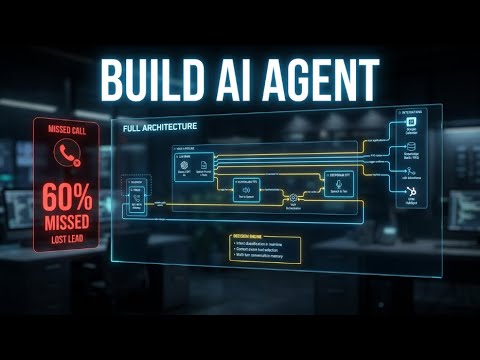
Build Your First AI Voice Agent (Full Architecture)
11 min · Apr 14, 2026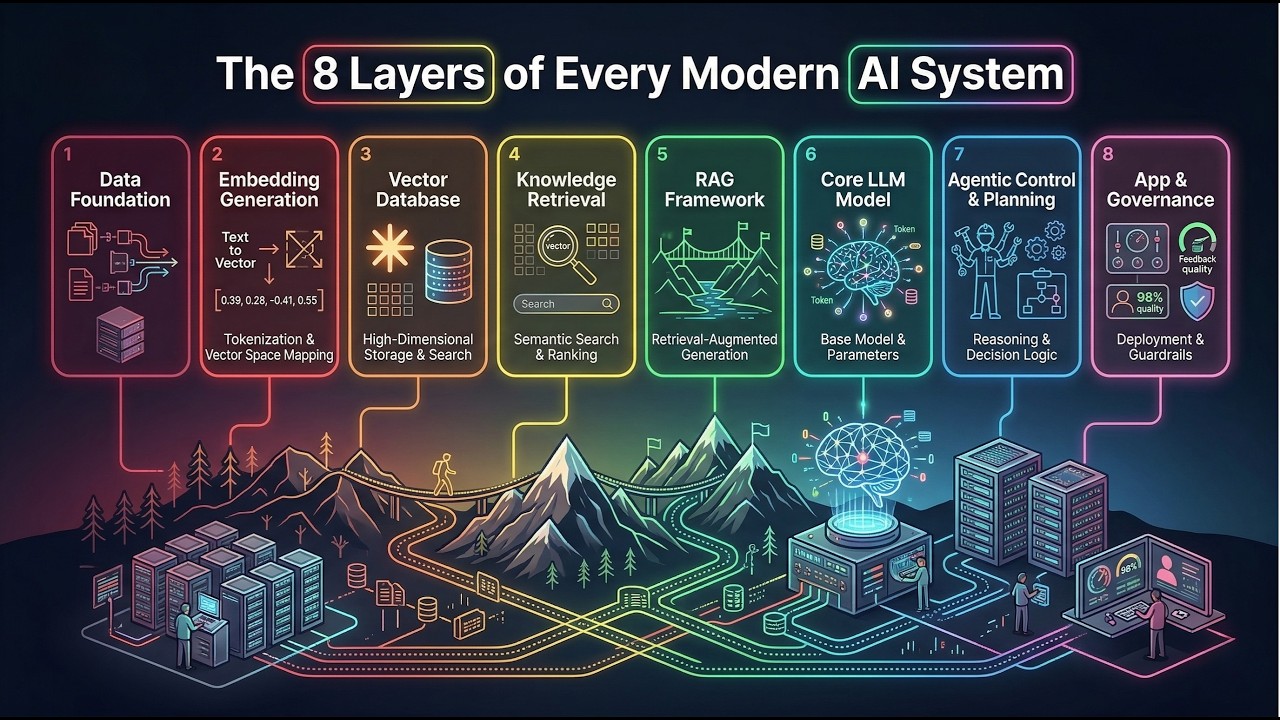
Why Most AI Engineers Build AI Wrong. The 8 Layer Reality
11 min · Apr 13, 2026
The 60% Problem Every Engineering Team Has
8 min · Apr 12, 2026
The AI Agent Platform War. Who ACTUALLY Wins?
7 min · Apr 11, 2026
The $0.08/hr AI Employee. Claude Managed Agents Pricing Breakdown
6 min · Apr 11, 2026Frequently Asked Questions
How do I build an AI voice agent?
The core stack is: Deepgram or Whisper for speech-to-text, Claude or GPT-4 for reasoning, ElevenLabs for text-to-speech, and Twilio for telephony. You connect them via WebSockets for low-latency streaming. The main engineering challenge is orchestrating these components to minimize end-to-end latency below 1 second for natural conversations.
What is the best text-to-speech for AI voice agents?
ElevenLabs is the gold standard for quality, with Flash v2.5 offering the best balance of naturalness and speed for real-time use. For lower cost alternatives, OpenAI TTS and Google Cloud TTS are solid options. The key metric for voice agents is latency to first audio byte — optimize for this over pure audio quality.
How much does an AI voice agent cost to run?
A typical voice agent call costs approximately $0.05-0.15 per minute, combining STT ($0.007/min with Deepgram), LLM ($0.01-0.05/min with Claude Haiku or GPT-4o-mini), and TTS ($0.02-0.05/min with ElevenLabs). At scale with negotiated rates, this can drop to $0.02-0.05/min, making it competitive with human agent costs.
How do I handle interruptions in an AI voice agent?
Interruption handling requires detecting the user speaking while your agent is speaking (barge-in detection). This is done by monitoring the STT stream in parallel with TTS playback and immediately stopping audio output when speech is detected. Most production systems use Voice Activity Detection (VAD) from Deepgram or a local model like Silero-VAD for this.
More Topics for AI Builders
Built for AI Builders who ship.
New videos every week on AI Voice Agents and the full AI builder stack. No fluff — only what you can apply in production immediately.
Subscribe on YouTube