How to Build AI Agents
Step-by-step tutorials on how to build AI agents from scratch. Covers tool use, memory systems, planning loops, agent orchestration, and deploying autonomous agents in production.

Eight Labs
AI Builder Education · TheAIHow · Updated April 2026
What is How to Build AI Agents?
AI agents are software systems that use a language model as a reasoning engine to autonomously plan, take actions, use tools, and complete multi-step tasks without requiring human input at each step. Unlike a standard LLM API call that returns a single text response, an AI agent operates in a loop: it reads its current context, reasons about the next best action, calls a tool (web search, code execution, API call, file write), observes the result, and decides whether to continue or stop. This perception-reasoning-action loop is what makes agents capable of completing goals that require multiple decisions. A single agent can browse the web, read and write files, call external APIs, manage memory across sessions, and delegate subtasks to other agents — making them fundamentally more capable than any single LLM interaction for complex real-world tasks.
Building production-grade AI agents requires understanding the core architecture: a reasoning loop (often called an agent loop), tool definitions, memory systems, and error handling. The most common mistakes AI builders make are designing agents that are too broad in scope, lack proper observability, and have no fallback when the LLM makes wrong decisions.
At The AI How, we build AI agents with real-world constraints in mind. We cover LangGraph for stateful agent orchestration, the MCP protocol for tool standardization, memory patterns for long-running agents, and deployment patterns that make agents reliable in production.
Key Concepts for AI Builders
- The agent loop is the core pattern: perceive (read context) → think (reason with LLM) → act (use tools) → observe (process result)
- Tool definitions are the primary interface between your agent and the outside world — well-designed tools make agents dramatically more reliable
- Memory systems (short-term, episodic, semantic) determine what your agent can remember across interactions
- Human-in-the-loop checkpoints are essential for high-stakes agent actions in production
- Observability with tools like LangSmith is non-negotiable for debugging agent behavior
Videos on How to Build AI Agents

Every AI Agent Failure Is a Context Failure. Here's the 5-Layer Fix.
7 min · May 13, 2026
Your AI Agent Will Be Hacked. Here's the Architecture That Stops It.
13 min · May 6, 2026
Claude Session Limits? Never Hit One Again
17 min · Apr 24, 2026
97% of AI Agents Fail in Production. Here's How to Build One That Doesn't
6 min · Apr 19, 2026
Build Your First AI Voice Agent (Full Architecture)
11 min · Apr 14, 2026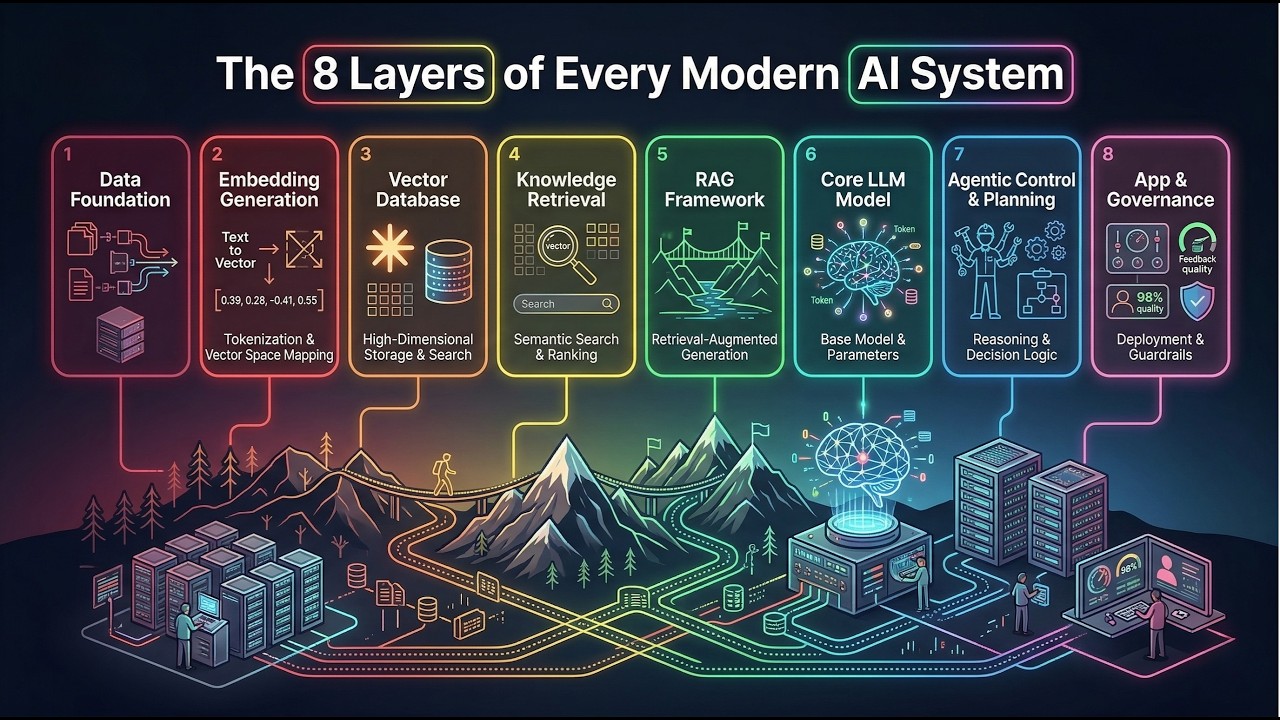
Why Most AI Engineers Build AI Wrong. The 8 Layer Reality
11 min · Apr 13, 2026
The AI Agent Platform War. Who ACTUALLY Wins?
7 min · Apr 11, 2026
The $0.08/hr AI Employee. Claude Managed Agents Pricing Breakdown
6 min · Apr 11, 2026Frequently Asked Questions
What is an AI agent?
An AI agent is a system that uses a language model to autonomously reason, plan, and take actions to complete goals. Unlike a simple LLM call that returns text, an agent can use tools (web search, code execution, API calls), maintain memory, and chain multiple steps together to complete complex tasks.
What is the best framework for building AI agents in 2026?
For Python, LangGraph is the most production-ready framework for stateful multi-agent workflows. For simpler agents, direct API calls with tool use (using the Anthropic or OpenAI SDK) give you the most control. CrewAI is good for role-based multi-agent setups. The right choice depends on your complexity requirements and state management needs.
How do I make AI agents reliable in production?
Production reliability requires: structured output validation to catch malformed LLM responses, retry logic with exponential backoff, human-in-the-loop checkpoints for irreversible actions, comprehensive logging of every step, and fallback behaviors when tools fail. Start with narrow, well-defined agent scope before expanding capabilities.
What is the difference between an AI agent and a chatbot?
A chatbot responds to conversational inputs with text. An AI agent can take actions in the world: browsing the web, writing and executing code, calling APIs, managing files, and chaining multi-step tasks autonomously. The key difference is agency — the ability to act, not just respond.
More Topics for AI Builders
Built for AI Builders who ship.
New videos every week on How to Build AI Agents and the full AI builder stack. No fluff — only what you can apply in production immediately.
Subscribe on YouTube